

TPMS – Review of Promata MATA-2E
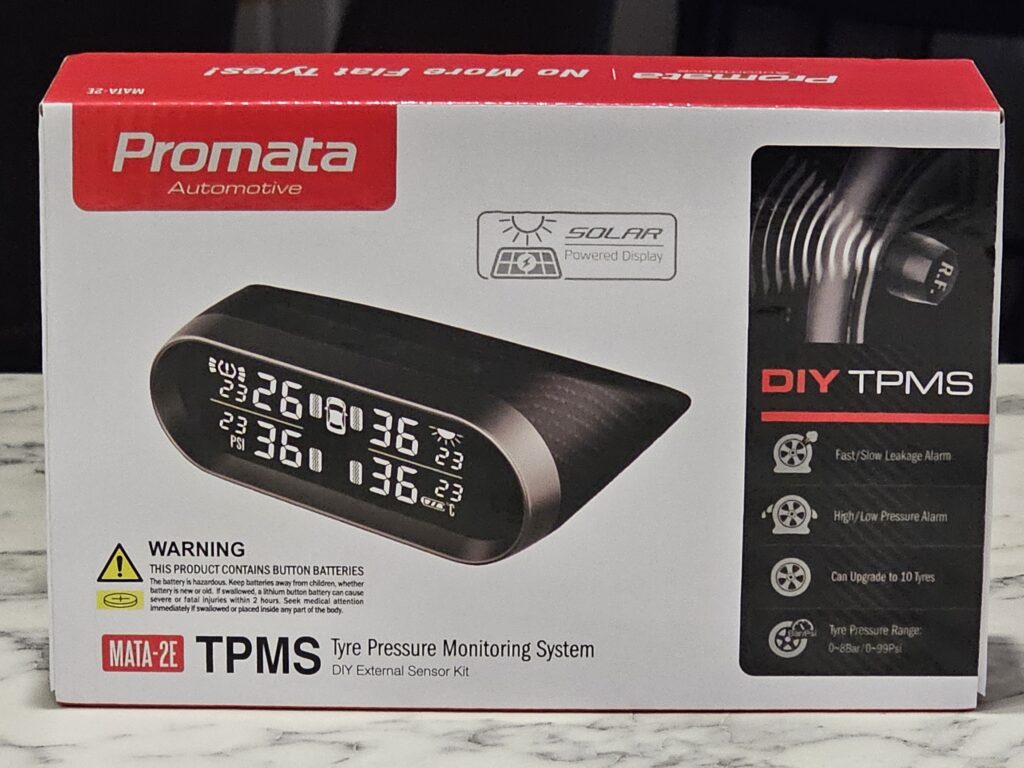
I was approached by the guys at Promata Automotive to see if I was interested in doing a review on their Solar Powered MATA-2 TPMS for 4WDs, Caravans and Towing. Since I had a been playing with a few different models I thought why not! Also the Safety Dave unit I had was sold with the caravan. As per my statement on reviews, I am noting that this item has been supplied to me at no charge in return for my review. This review is based solely on my personal experience with this product, all photos have been taken by me of this item as delivered.
So first impressions is it looks nice and compact and aesthetically should not look out of place sitting on the dash. Opening the box and its well packed, has spare rubber valve seals, double sided tape or Velcro to hold in place on the dash and a tool for removing the lock nuts for the valve senders and for dismantling the sender unit to replace the battery when required.

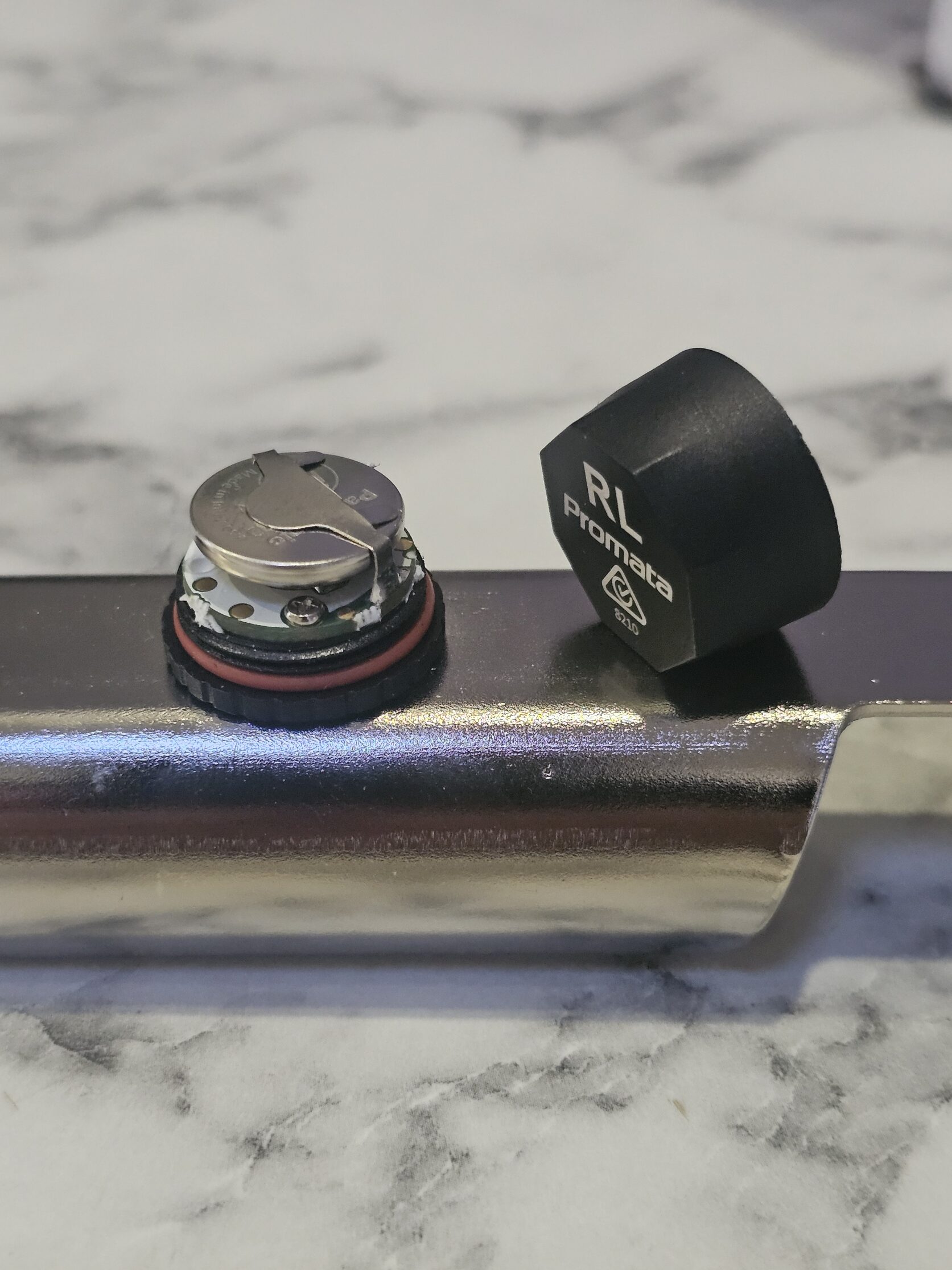
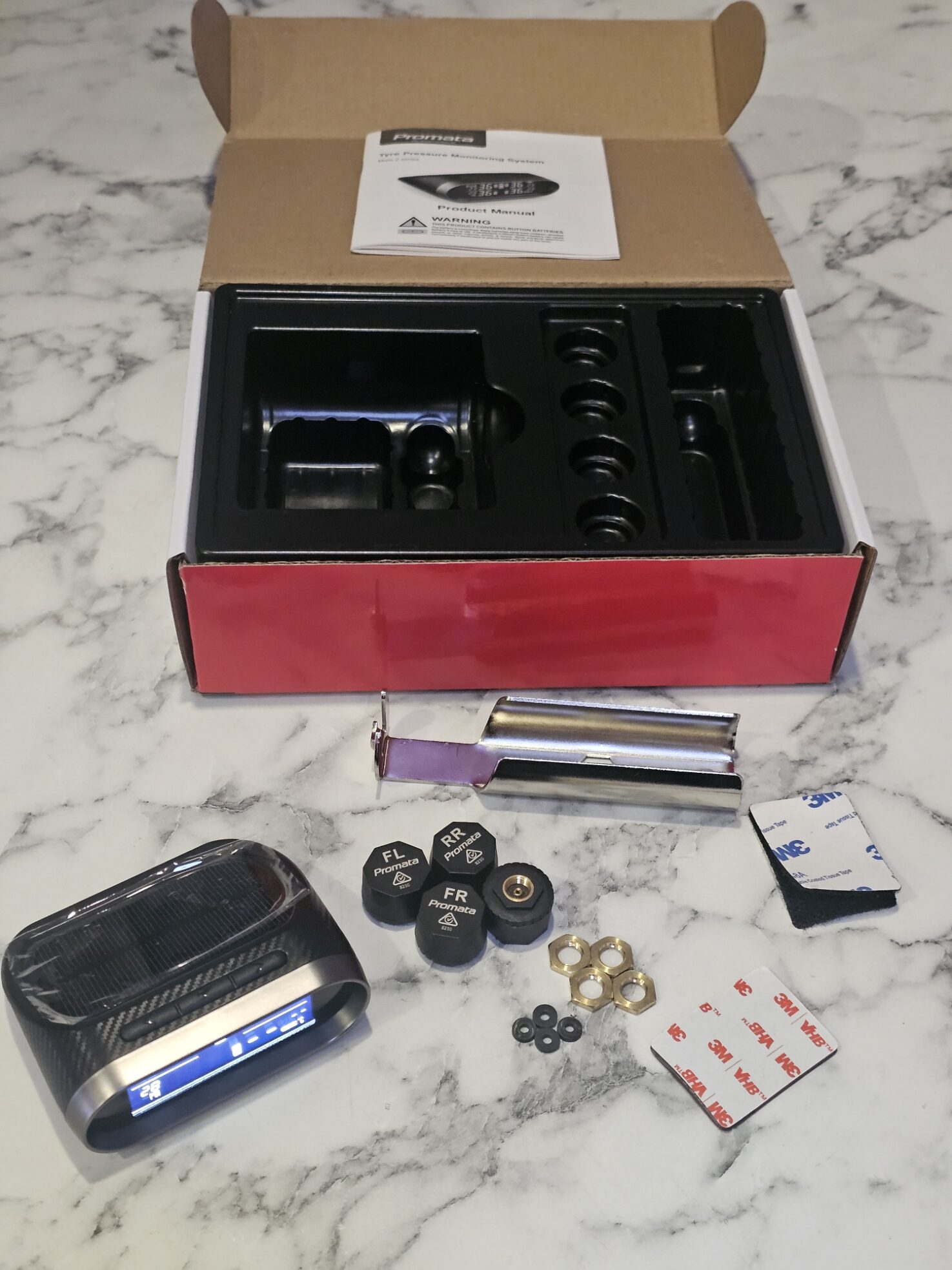
Sender units are sealed with a red rubber o-ring, though no sign of any grease or lubricant to assist with sealing. From experience, you would probably want to add a little smear of rubber grease to the o-ring if you intend driving through water crossings. Senders come fitted with a CR1632 Lithium button battery, rated at approx 2 years life span. These are readily available for replacement, Woolworths even stock them.
The user manual is by far the most comprehensive of any of these units I have seen, covering all programming options. Default programming actually was perfect for my usage, with the low pressure alarm set for 29PSI (2.0 Bar), high pressure alarm 43 PSI (3.0 Bar) and high temp alarm at 80° C. My tyres on my test vehicle run at about 35PSI cold and rise to around 39PSI max. All those alarm levels are of course user settable and the manual describes the process quite well. There is an alarm not mentioned in the manual I noticed, a sudden pressure change alarm. Whilst parked a few days ago one tyre dropped from 37 to 35PSI and as soon as I moved the car the alarm went off to advise of a rapid drop, even though still above the minimum threshold. This is an alarm for rapid deflation – mentioned on the box but not in the instructions. (Will cover why that happened later on).
The display is easy to read and viewable from above and the sides, but not very clear from below (which is not an issue anyway)
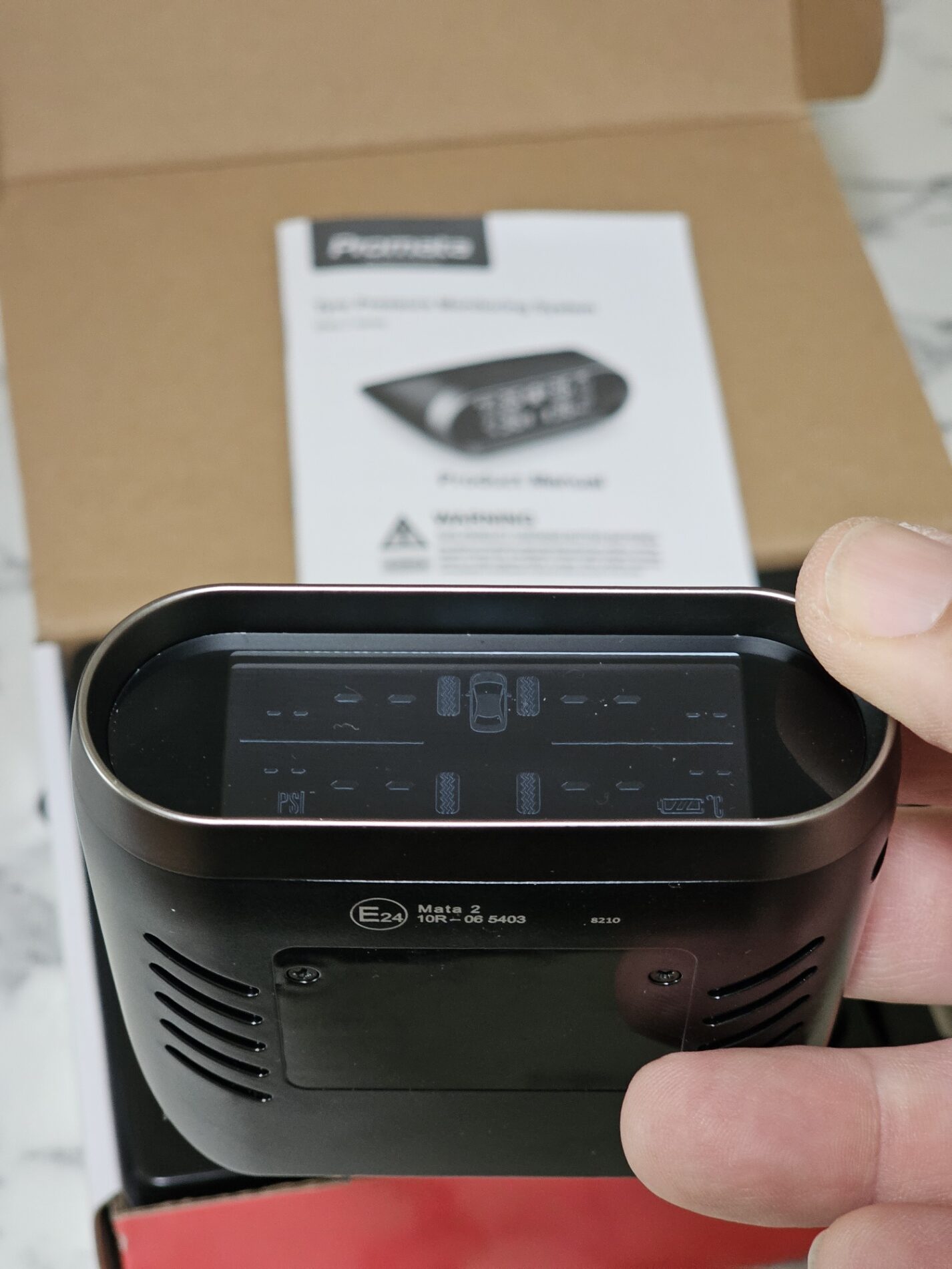
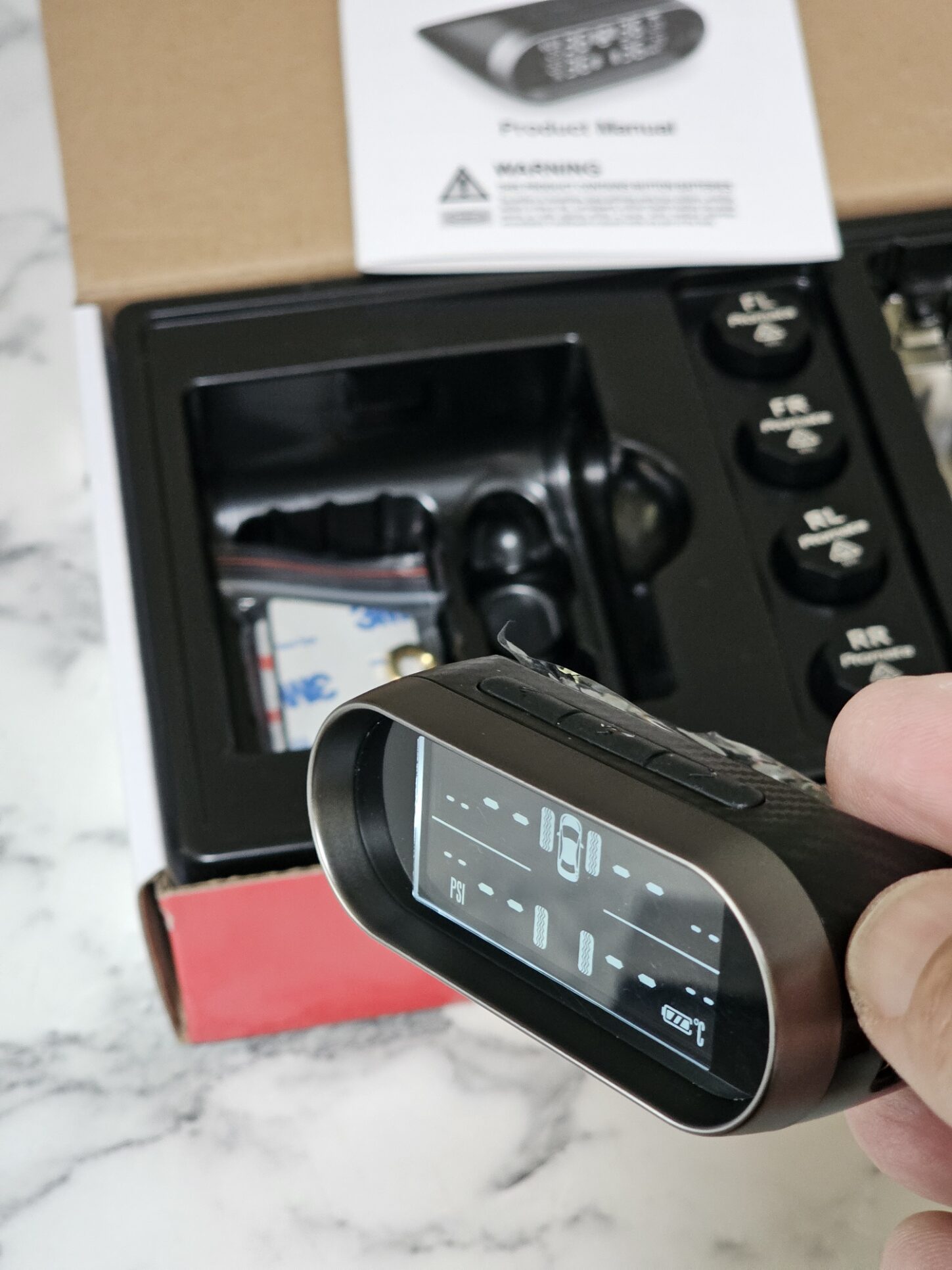
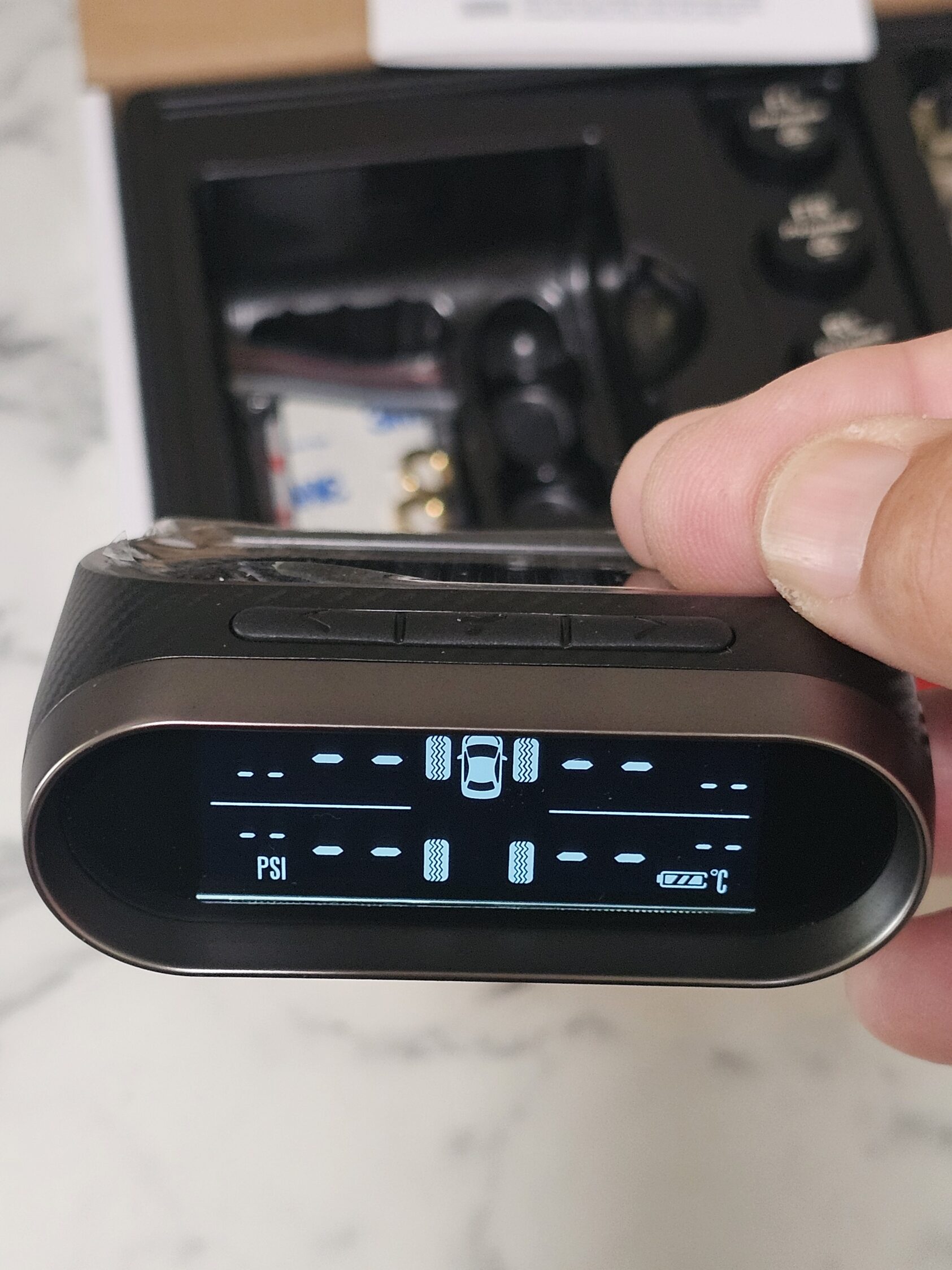
So install – well that pretty boring I must say. As I mentioned above the defaults covered my usage requirements so I thought I would see how went straight out of the box. Simply remove the valve caps and screw on the relevant sender (each is marked with the wheel location, ie, RR for Right Rear, LF for Left Front etc). Turn on the display after charging for a few hours via USBC as per the instructions (was about 50% charged out of the box) and it just worked. When on the dashboard and the car is parked the unit (and display) will turn off. Vibration of closing the door will normally turn it back on, once so far I have started to drive away and it wasn’t on – I tapped the dash with my hand and it fired straight up. I don’t consider that a problem.
Since this is only a temporary install I have it sitting on an anti slip mat dash right at the base of the windscreen. Please note this is NOT the correct location for it, it should be on the dashboard so the solar panel can keep the battery charged. Whilst it is not noted in the user manual, the Supplier has advised me (and it is noted on the website page for this unit) that it should be over near the A Pillar and preferably near a vent for fresh air. The system has the highest heat and sun rating, but there is simply no airflow that close to the windscreen and heat damage may result.
It also brought a couple of other issues sitting it there, the display reflected off the windscreen, and I couldn’t reach the buttons. The reflection was not as obvious while driving and when located away from the glass where it should be, this won’t be a problem at all. It also drops in brightness after a minute or two during the day and then substantially dimmer again at night so its not distracting at all, but always readable. And again, it should not be sitting against the glass anyway.
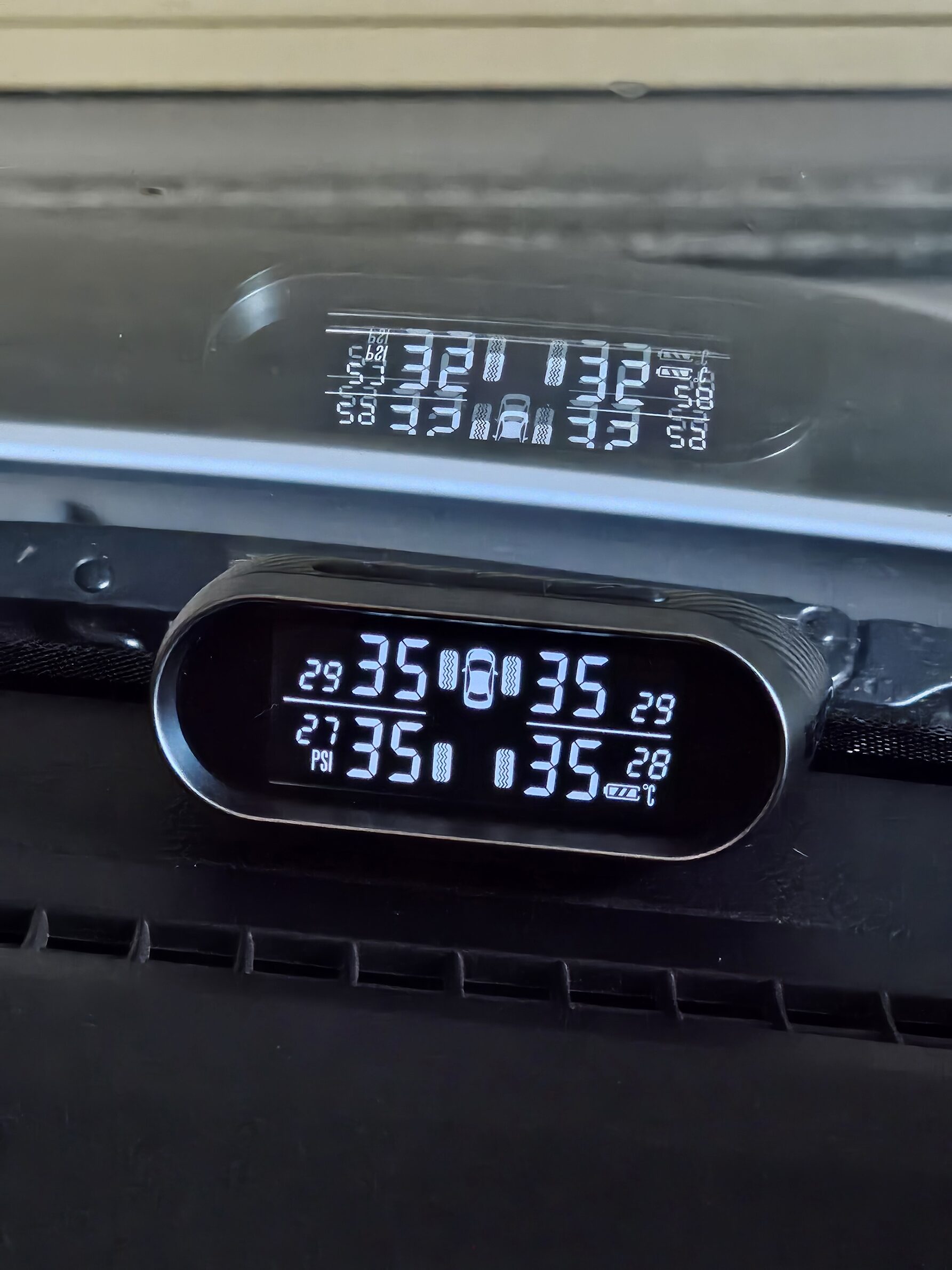
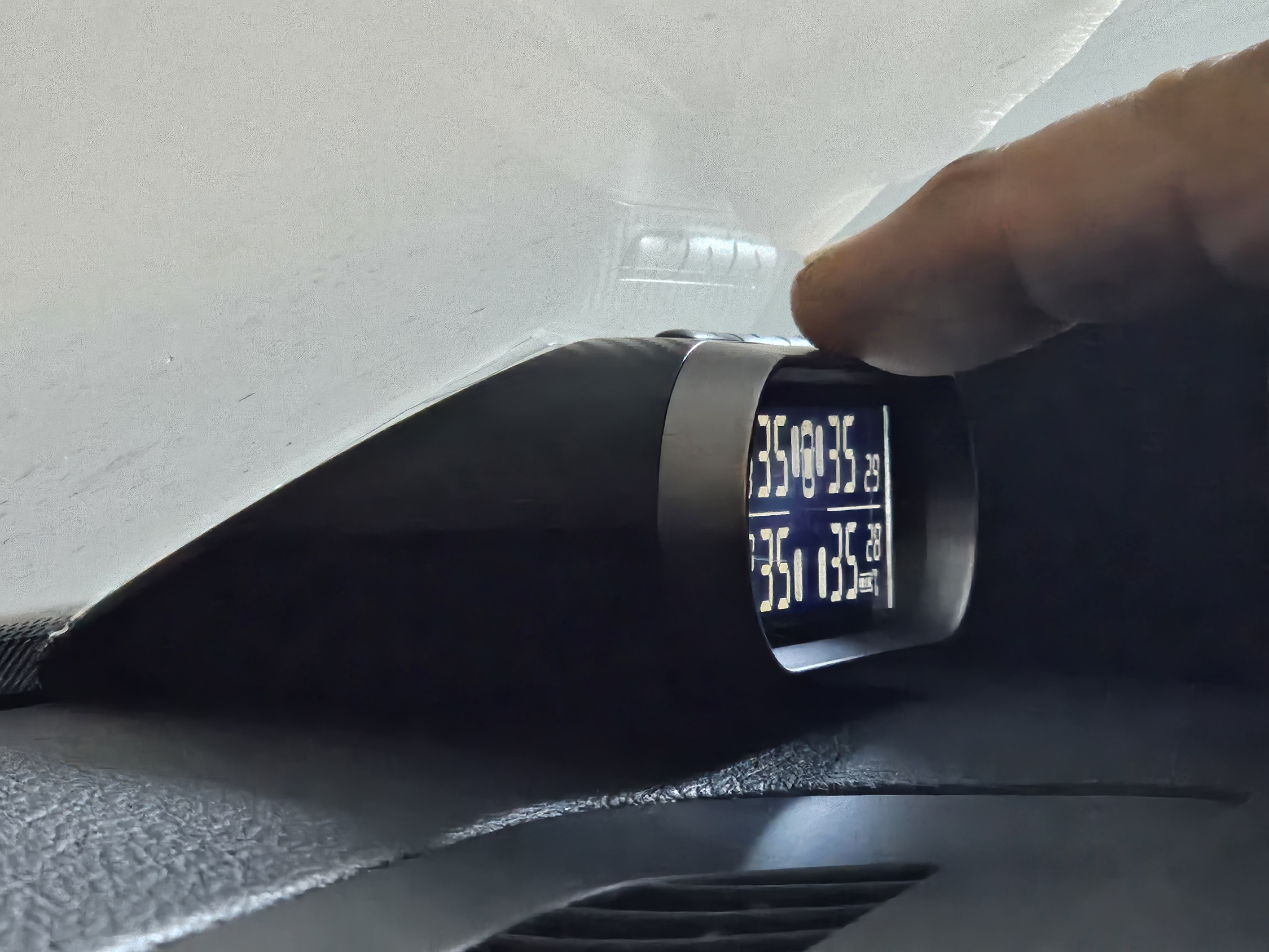
The vehicle I am testing it on has internal TPMS sensors (hence why I only have a very temporary install), so I already know what the tyres are at and it was good to do a comparison. Most of the time they were identical, and when not, they were within 1 PSI of each other. So very happy with the accuracy and the speed that changes are reported. This basic kit does not come with the optional Trailer Booster unit, I don’t require it for my usage but from past experience I would recommend it if you are fitting this to your caravan. I found the alloy body of the vans interfered with the range of the senders.
Any downsides? Nothing that I would call a deal breaker, however one design flaw did stand out to me. The USBC charge port (Cable not supplied, need to use your own cable and charger) is located on the lower of the right side. As the sides are curved the port angles down at around 30 degrees. This means if it is double sided taped to the dash as an more permanent install, you can not plug in the charge cable if required. For this reason I recommend using the Velcro option so you can remove easily when needed or when not required (i.e. if using for towing only).
Did it work? Yes, worked great! However I mentioned above a tyre ‘rapidly deflated’ 2 PSI. That has occurred 4 times now over two weeks and now I have identified one thing that is happening. The first time I coincidentally thought I had a small leak in one tyre (see update 3 below for the full story) and the pressure dropped 2 PSI since the last time driving, the other 3 times was after long drives. What happens there was the tyre temperature increases and the pressure increases around 3 to 4 PSI. Then pull up and park for a few hours, tyres cool down, jump in drive off and the sensors update (they stop updating when not moving) and of course there is an instant 3PSI drop – the system was seeing that as a rapid deflation and set off the alarm for 3 seconds. Then the next tyre updates and the alarm goes again, then again, then again… I just did a trip away over the weekend (3 hours away), we arrived and parked and didn’t move the car for half a day. Got in to move off and off the alarms went. Same again after the trip home, arrived and parked in the garage, didn’t move the car until next morning, jump in and tyres all showing 39PSI, 20m later they all drop on by one to 35PSI setting off the alarm. The user manual does not mention this feature or any ability to program the parameters, so I don’t know if it can be changed. The internal Jeep TPMS also recorded the change as well, but did not alarm as it only alarms on reaching a minimum pressure (see Update 1 below for a solution).
UPDATE 1: Supplier has advised there is a ‘Fresh Data’ mode – this will force the unit to ignore previous data when it starts up and await for fresh data to arrive before displaying so this should alleviate the issue above of thinking there is a rapid deflation when sitting for a few hours after a long drive. With the unit on, press and hold the left and right button simultaneously until it beeps and lines appear on the display (about 5 seconds). To change back is the same procedure, but 8.8 shows momentarily instead of the lines. https://www.youtube.com/watch?v=nN_7OtsKLe8
UPDATE 2: A week later and I can confirm the Fresh Data mode works much better. As soon as you jump in the unit lights up with — for each tyre, then within 20 to 50 metres of driving off all 4 tyres have been updated (usually by the end of the driveway). Perfect.
UPDATE 3: After a couple of weeks and swapping the tyre sensors around to try and work out if it was the sensor or the tyre, the left rear tyre of the vehicle continued to slowly deflate, so I assumed that coincidentally I had a small leak in the tyre (puncture) that happened at the same time as the install and start of testing. However I have now removed the system for a week and the tyre has stopped deflating. What the?? The top of the valve stem on that tyre must not be sealing properly on the sender unit? I took a high resolution photo and zoomed in and found the very end surface of the valve stem valve had a few dents in it (manufacturing deformity?). This appears to have stopped the sender unit from sealing properly. Problem finally solved. Only recourse though would be a new valve stem I suspect.
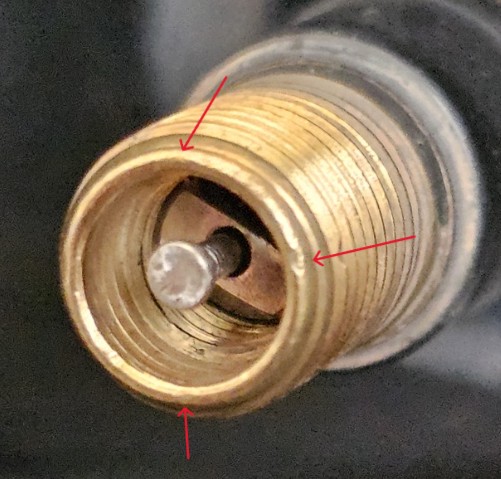
UPDATE 4: I have given this into to a friend who is an Uber Driver but his car does not have factory TPMS and had a flat tyre only a couple of weeks earlier spotted by a passenger. It has worked well for him, detecting a slow leak and enabling that to be fixed before damaging the tyre. However he has noticed the solar doesn’t charge it enough when used most fo the day and has to plug it into the USB every few weeks to top the battery up again. Probably not an average use case and most people would have their vehicle sitting idle for most of the day, and if outside it will be charging the battery while the display is off, not drawing from the battery. I would not class that as an issue, just a particular use case observation.
The supplier has a whole series of video guides, the playlist is :
https://youtube.com/playlist?list=PL-BhUx1ManhR7QdWiDgpEsqfBa2wGVxOn&si=OefwE8rVKXL3EIes
Overall opinion? Yes, I would recommend this unit, priced well ($199 RRP at time of writing), expandable up to 10 senders, 3 display pages for Car, Trailer and Spare tyres, optional Booster for longer trailers, easily user programmable and aesthetically looks great. Oh and of course its solar charged so set and forget until a sender battery runs low after 2 years or so – that is also alerted through the display.
That link again: Promata Solar Powered MATA-2 TPMS for 4WDs, Caravans and Towing
Recent Comments